
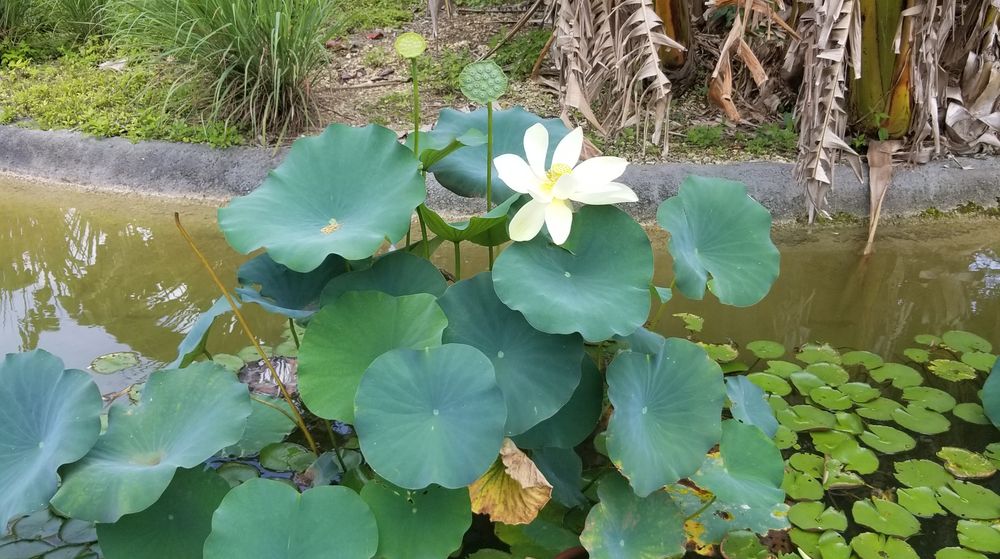
Post #44 Water Gardening
If you live in South Florida, we’re going to go out on a limb here and guess that you like the water. A water feature in your garden allows the simple sensory pleasures of water to exist in your daily life, even when you can’t get to the beach.
A water garden can be large or small, and there are many plants to fit in. You can even grow small and dwarf water plants in a container.
This post is focused on planning and maintaining your water garden successfully.
We’ve included lists of plants, organized into different zones or layers of a water garden, that we find grow successfully in our climate zone 11a.
Choose Your Plants
Choose plants that will fit in the space you have. Find out how large they will be when mature, and plan so you do not cover more than two thirds of the surface with mature plants. Choose plants that will benefit wildlife, and be sure to include some native plants in the mix.
Plan the Environment
Water features come in all sizes, from small tubs to large ponds spanning acres, so there are possibilities for everyone. Decide how much space you have, and where, then visit a water garden nursery. They have the equipment, plants, and know-how to set you up and help if any problems arise.
Maintenance
Controlling Weeds
- Algae – algae needs sun, so shading much of the surface helps. Excessive nitrogen can cause overgrowth of algae, so don’t overfeed your water plants. Use a slow-release fertilizer.
- Beneficial Bacteria – beneficial bacteria can keep algae down. Plants and rocks under the water give these bacteria a habitat to colonize in, so make sure there are plenty of these. Beneficial bacteria and barley balls can also be added to the water to help control algae.
Work closely with your water plant nursery staff to help you plan a water feature and set a maintenance schedule.
Tips For Safe and Sustainable Water Gardening Success
- DO NOT, let me repeat, do not plant water hyacinth. This plant may beguile you with its beauty, but it is considered one of the worst water weeds in the aquatic world. You have been warned!
- Do not take plant material from natural bodies of water for propagation. They can spread diseases to your other plants, and you may not have identified them correctly.
- Our native mosquito fish (Gambusia) are useful for keeping mosquitoes down.
- If you are concerned about mosquitoes, remember that their predators, including dragonflies, will also be drawn to water instead of resorting to pesticides, which might kill delicate desirable wildlife along with the mosquitoes. Try mosquito dunks, a safe alternative.
- Mosquitoes don’t like moving water, so install a pump to deter them from getting too cozy.
- Check plants against the Center for Aquatic and Invasive Plants directory before bringing them in. (https://plants.ifas.ufl.edu/plant-directory/) This resource will tell you which plants are native to Florida and which are invasive.
The Plants
Most of the plants listed are native to Florida. As in a forest garden, there are layers in a water garden. Use the guide below to choose the perfect variety of water plants for your garden.
Riparian Plants
You will find these plants around the edges of water. They appreciate the moist soil and can handle occasional flooding.
- Bacopa (B.monnieri
- Blue Flag Iris (Iris virginica)
- Bog Sage (Salvia uglinosa)
- Cannas (Canna spp.)
- Royal Fern (Osmunda regalis var. spectabilis)
Emergent (or Emersed) Plants
These plants are rooted in the soil in the shallow areas around the edges of a natural pond. Or you can grow them in pots submerged in at least two inches of water.
- Alligator Flag (Thalia geniculata)
- Arrowhead (Duck potato, Sagittaria spp.)
- Cattail (Typha latifolia)
- Pickerelweed (Pontederia cordata)
- Rushes (Juncus spp.)
Deep Water Plants
These plants are rooted in the soil at the bottom of the pond, but their leaves and flowers show above the water.
- Lotus (Nelumbo spp.)
- American Lotus (Nelumbo lutea)
- Sacred Lotus (Nelumbo nucifera)
- Spatterdock, Cow Lily (Nuphar advena)
- Water Lily (Nymphaea sp.)
- Yellow water lily (Nymphaea mexicana)
- Fragrant water lily (Nymphaea odorata)
Submersed Plants
These plants grow entirely underwater, though sometimes their leaves may show a little above the surface. They help keep the water clean and generate oxygen for the living creatures in the water, such as fish.
- Baby’s Tears (Micranthemum sp.)
- Coontail, Hornwort (Ceratophyllum demersum)
- Fanwort (Cabomba caroliniana)
- Lemon Bacopa (Bacopa caroliniana)
- Pondweeds (many spp.) – make sure the ones you plant are not invasive.
- Florida natives include:
- Waterthread pondweed (Potamogeton diversifolius)
- Florida pondweed (Potamogeton floridanus)
- Illinois pondweed (Potamogeton illinoensis)
- Long leaf pondweed (Potamogeton nodosus)
- Sago pondweed (Potamogeton pectinatus)
- Clasping leaf, Clasped leaf pondweed (Potamogeton perfoliatus)
- Small pondweed (Potamogeton pusillus)
- Richardson’s pondweed (Potamogeton crispus)
- Non-Native Invasives to look out for:
- Curlyleaf pondweed (Potamogeton richardsonii)
- Florida natives include:
Floating Plants
Not rooted in the soil at all, these plants float freely on the surface.
- Bladderwort (Utricularia spp.)
- Little Floating Hearts (Nyphoides cordata)
A note on water gardens in part shade
Normally, a pond needs about 6 hours of sun per day, so it’s best to situate them in full sun. However, it’s not impossible to have a water feature in some shade.
A shady spot is good for a small waterfall or bubbling feature, but there are also water plants that can handle some shade. They won’t flower as much, but will still grow fine.
Water Plants that Tolerate Shade in Zone 11a:
- Baby’s Tears (Micranthemum spp.)
- Bog Bean (Menyanthes trifoliata)
- Golden Club (Orontium aquaticum)
- Horsetail (Equisetum hyemale)
- Lizard’s Tail (Saururus cernuus)
- Marsh Marigold (Caltha palustris)
- Royal Fern (Osmunda regalis var. spectabilis)
- Water Hawthorne (Aponogeton distachyos)
The benefits of water gardening are manifold. Water plants increase habitat and food for wildlife and help keep the water clearer, and if they are planted in the soil, they can help prevent erosion.
Water gardens attract beneficial insects such as dragonflies, who love to gobble up mosquitoes and their larvae. Bees appreciate a cool drink. Frogs need water and will eat insects. Lizards and snakes also like water and eat pests. Birds enjoy a splash bath in shallow spots.
Creating a water garden is a boon to the micro-ecosystem you are creating with your forest garden. All of your plants, and wildlife around, will benefit.
Are you thinking of installing a water feature in your garden? Or have you already? Share your thoughts, ideas, general ponderings in the comments below. We love to hear from you!
Until next time, happy gardening!
Mary