
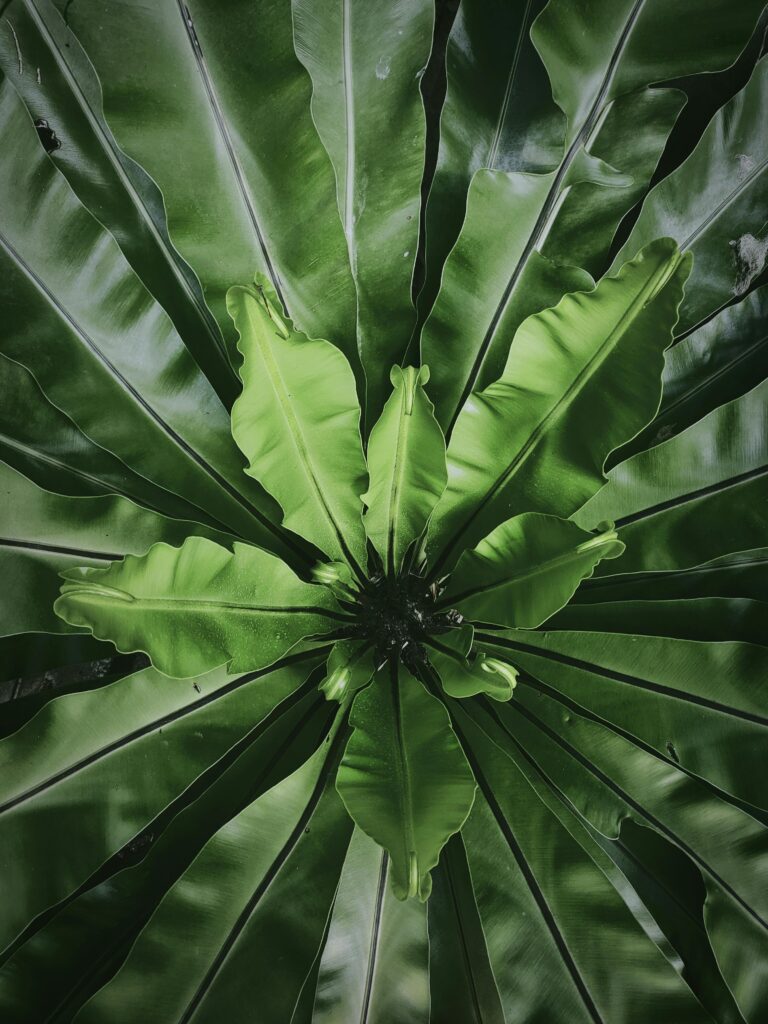
Post #78 Plant Profile: Bird’s Nest Fern (Asplenium nidus & Asplenium australasicum)
Today our focus is on an omnipresent South Florida plant, the bird’s nest fern. A versatile plant that accepts containers, does well indoors, and flourishes in deep shade, this fern is a no-brainer for your forest garden or living room alike in our climate.
This fern unfurls large, shiny green fronds reminiscent of banana leaves. Aptly nicknamed bird’s nest, the fronds curl back and brown as they mature, resembling a bird’s nest. There are many variations on appearance, from wavy margins or sides, to split tips and dwarf varieties. All are pleasing to the eye and easy to grow in our opinion!
Today we’ll dive into the common varieties, how to grow them, and conservation concerns for the Florida Native variety, Asplenium serratum. There are also varied opinions on the plant’s edibility, so we’ll discuss that too.
Asplenium nidis vs. Asplenium australasicum
There are many varieties of the bird’s nest fern, so we have chosen to focus on the two most commonly found in our area, A. nidus & A. australasicum. Both varieties are native to most regions of Asia and Australia.
Both species are epiphytes or air plants, meaning they readily grow on the surface of other plants. They gather their moisture and nutrition from rain, collected humus, and the air itself. If you’ve got palm trees, they nestle in very well there, too.
The Asplenium nidis fronds most resemble banana leaves, averaging about 4 feet long and just under a foot wide with a black midrib. The fronts are light green and smooth, sometimes with crinkled edges.
The Asplenium australasicum is a bit more shrubby in appearance, with smaller fronds averaging under 3 feet long and about 8 inches in width.
Besides the difference in size, a good way to differentiate the two is that the A. australasicum has a large midrib on the underside of its fronds, creating a large v-shaped crease along the top of the frond.
How do you grow Bird’s Nest Fern?
Although bird’s nest fern can be grown indoors as a houseplant, we are most interested in it for our suburban forest gardens. The ruffley fronds add a spectacular touch to a South Florida garden.
A true fern, this plant reproduces by producing spores on the underside of its leaves, which eventually drop down and become their own plant.
Bird’s nest fern is not drought tolerant and will turn brown and unhappy if exposed to too much sunlight. This plant is ideal for shady parts of your garden or areas of indirect sunlight inside.
The best time to repot or transplant bird’s nest fern is during a period of new growth, which is typically in the springtime.
Bird’s nest fern will thrive either as an epiphyte or a terrestrial plant. Either way, it does best in full shade and damp, not flooded, soil. It can do quite well with minimal soil but needs a steady supply of nutrients to thrive.
As an epiphyte it likes to grow on palm trees or any available larger plant that will support it really. The plant survives by utilizing water and humus that gets collected in its rosette or center for food.
As a terrestrial plant it does well in containers or even directly in the ground. A terrestrial fern that has outgrown its container can be successfully transplanted in the springtime when new growth occurs.
Pest Alert
These ferns typically do not have many pest issues, another great reason to love this easy grower.
Though uncommon, occasionally you find yourself dealing with nematodes, slugs, or snails. Simply pull the slugs and snails off. Nematodes are a bigger issue and any fern affected should be removed and destroyed (do not put in compost).
Native Species
Look out for Asplenium serratum L., a species native to South Florida and certain coastal pockets along the central and northern gulf coast. This variety boasts upright fronds with finely toothed margins or edges. The shiny, unlobed leaves grow up to around 2.5 feet long. Its exposed roots are decidedly brown and hairy, making it easy to identify.
A. Serratum L. has all but died off in the wild except for Southern Florida, so if you come across it, please let it be!
Where can you find Bird’s Nest Fern for sale?
Readily found at local nurseries is South Florida, you can also do a quick google search to round up many online nurseries that sell this plant. And, as always, if you notice a neighbor growing them, see if you can take some babies to transplant.
Can you eat Bird’s Nest Fern?
The short answer is yes. It is a common vegetable served across Asia. The young shoots are sauteed with anchovies or cooked and eaten by themselves with a light dressing. They are also served deep fried or cooked in coconut cream.
The young shoots do not have much flavor, but are used more for their satisfying crunch and bright green color to perk up any dish as a side or bed of cooked greens to showcase a main protein such as duck.
The long answer is that there is much controversy surrounding edibility of bird’s nest fern. The plant contains insoluble calcium oxalates. These are toxins that can cause pain, inflammation, or swelling in the intestinal tract when consumed. They can also cause difficulty swallowing, nausea, and vomiting in more extreme cases.
Our overall take on edibility:
It may be non-toxic, but eat bird’s nest fern at your own risk, using traditional recipes. Eat only the young curled fronds, and they must be cooked.
Don’t use them as a wrap for steaming food because that requires the older leaves, which have more toxins in them, and that will transfer to any food steamed inside. Ti leaves and Banana leaves are best suited for this purpose, and very safe.
What has been your experience, if any, with this plant? Have you ever eaten it at a restaurant or been brave enough to prepare it at home? I’ve never tried it. I much rather use it as a beautiful perennial to fill in the shady parts of my garden where many other plants will not grow.
Let us know your thoughts in the comments below, we love hearing from you!
Until Next time,
Happy Gardening,
Mary