
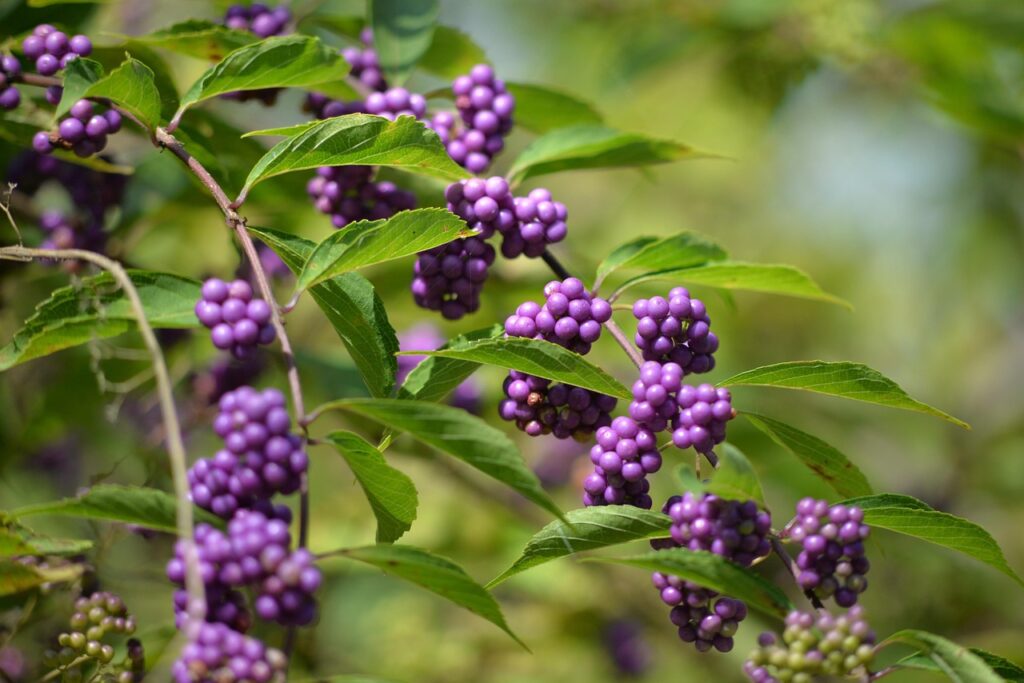
Post #89 Plant Profile: Beautyberry (Callicarpa americana)
Beautyberry. Just the name evokes something tantalizing and nutritious. Also called a mulberry bush in certain circles, this plant is foraged in the wild for food and celebrated in the garden as a stunning ornamental.
This sprawling shrub grows naturally in open meadows, woodlands, alongside marshes and streams, and in ditches. A member of the mint family, it has woody, multistemed branches that sprout large, toothlike leaves in April and clusters of buds that give way to tiny white flowers in the late spring through summer. The clusters of flowers ripen into fruits in late summer.
Native to the southern United States, the berries are ripe from late August through October in most areas. With its generous clusters of tiny, shiny deep purple berries and delicate, bright green leaves, this bush turns heads, especially when encountered in the wild. The berries contain several seeds and the clusters are called drupes.
Bird Food
Beautyberry is a favorite food source among many migrating birds. Specifically, cardinals, mockingbirds, finches, and woodpeckers love to indulge in these plentiful berries. In fact, the shrubs are often planted in ornamental gardens to attract birds for bird watching.
Deer love the berries as well, so if you are trying to keep a local deer population out of your garden, plant beautyberry on the outskirts of your property. Generally, here in suburban South Florida we are not contending with this, but some of you may have properties bordering open space – so beware of hungry deer!
Beautyberry shrubs are also a food source for bees and butterflies. These shrubs are larval hosts for spring azure butterflies and snowberry clearwing moths too.
Insect Repellent
There are several compounds in the leaves of beautyberry shrubs that deter mosquitoes (specifically the variety that carries malaria), fire ants, and even ticks.
Crush the leaves and rub onto skin, or simply leave the freshly crushed leaves around your outdoor space when sitting out during twilight to deter mosquitoes.
Beautyberry Jelly
The pretty bright purple berries of the beautyberry shrub don’t taste like much and shouldn’t be eaten in large amounts due to their astringent quality, but they are good in jelly.
While they are a food source for humans right off the bush, eating too many beautyberries at once generally causes stomachaches and can cause stomach cramping in some individuals.
The roots are traditionally used to make herbal tea and the berries themselves are sometimes used to make a light wine.
Back to that scrumptious jelly. Beautyberry jelly has a light, delicate taste and a deeply impressive purple hue. There are many variations of recipes out there, but here is a basic recipe to get you started if you’ve got a pile of ripe berries.
Ingredients
1 quart beautyberries, stems removed
About 6 cups water
1 package pectin
3 cups sugar
2 tablespoons lemon juice, fresh squeezed
Directions
- Sterilize 8-10 glass jelly jars, set aside.
- Place sorted and washed berries in a saucepan. Pour in water until the berries are just fully immersed.
- Bring to a boil, then reduce to a simmer for about 20 minutes, keeping an eye on it and stirring occasionally. Use a potato masher to gently crush the simmering berries.
- Strain the liquid through a metal sieve into a large glass measuring cup, reserve the berries for compost.
- Place the liquid back in the rinsed saucepan, noting the quantity. You should have between 2-3 cups of juice.
- Following the directions on your pectin packet for ratios, combine the sugar and lemon juice with the liquid.
- Stir and bring to a boil, then reduce to a simmer for about 15 minutes. Continue to stir frequently as it thickens so it doesn’t burn to the bottom of your saucepan.
- Pour finished jelly mixture into the sterilized jars.
- At this point you can either move to a canning bath for longer shelf life or simply place cooled jars into the refrigerator.
- Let the jelly set up for at least 24 hours before sampling. Enjoy!
Note: Don’t have time to make jelly now but your bush is full of berries? They freeze well, so freeze them at their peak and make jelly when time allows (you may need to reduce the amount of water you use if using previously frozen berries).
How do you grow Beautyberry Shrubs?
They do well in containers as well as directly in the ground. Grow a bush or three to attract wildlife, maybe in an area of your yard where you fancy a butterfly garden or pollinator garden. They are at home in a South Florida native garden too, if that is the route you are taking with your yard space.
Grow beautyberry from cuttings or germinate ripened purple seeds in pots.
To get the shrub started from a cutting, strip the bottom leaves off of a 10-12 inch cutting, leaving the top leaves to grow. Use a rooting enzyme to speed up the process if desired, then stick the cutting in a container or a prepared in-ground bed filled with rich soil.
You can also scatter the seeds on the ground where you want a bush or two to grow, cover them with a thin layer of soil and press them into the ground with your feet. They may sprout just fine in poor quality or sandy soil, but a prepared bed with an inch or two of rich soil will give the seeds a better chance at success.
And of course, be sure to keep the bed evenly moist until the seeds sprout and the plants become established. The shrubs will be somewhat drought tolerant once very-well established.
Once established, they are easy keepers that have no significant pest issues and are generally free from diseases, thus a very hardy (and beautiful!) plant to grow in your garden.
Cut the shrubs back and remove old canes in winter after the berries and leaves have died off. A good pruning will ensure a full and bushy shrub come spring.
Where can you find beautyberry for sale?
You’d be hard pressed to find the ripe berries for sale – but maybe during the peak of the season, September, you may find a vendor at a Farmer’s Market with a basketful. You are more likely to come across the jelly, or even wine, for sale at local markets.
If you are looking to procure a plant to add to your landscape, try the local nurseries first, and if all else fails go online, you’ll find them there.
A Word to the Wise – There are several non-native species, including a Japanese variety, Callicarpa dichotoma, that are considered invasive in some parts of the Southern United States – stay away from planting these.
There are also variations of Callicarpa americana, such as Callicarpa alba and lactea that produce white berries, so if you are after those striking purple berries, pay attention to the variety you choose.
Have any of you, dear readers, ever tried using beautyberry leaves as an insect repellent? I haven’t, but I am going to try it out this summer. It certainly seems better than spraying DEET all over my ankles and toes when out on the back porch at sunset.
Oh, and if you have a beautiful beautyberry growing in your garden already, snap a picture and share in the comments below. We love hearing from you!
Until Next time,
Happy Gardening,
Mary