
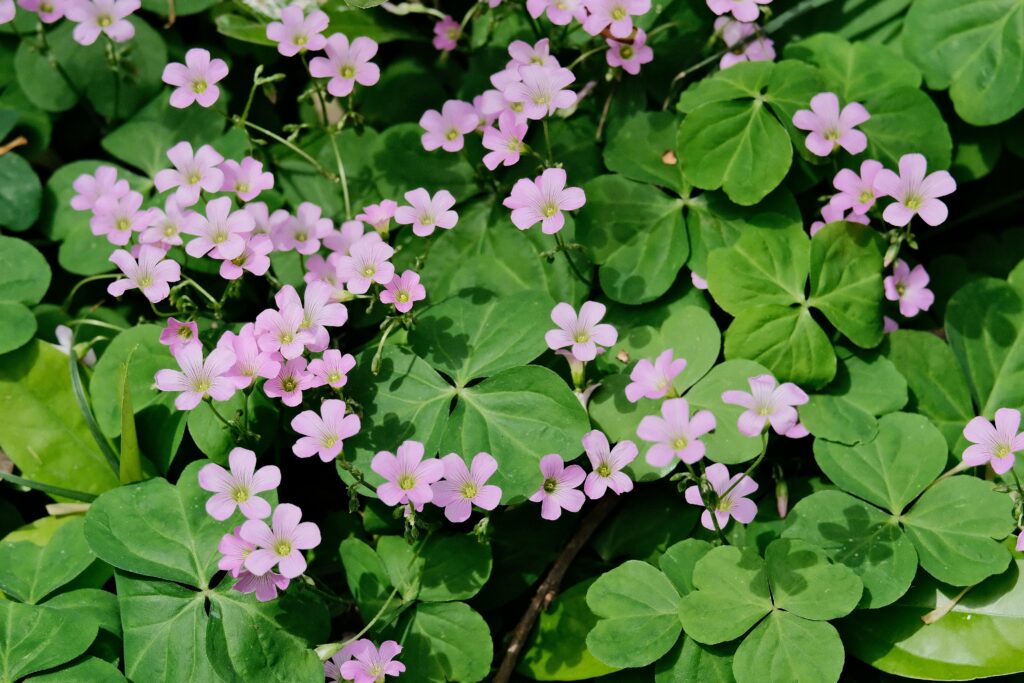
Post #90 Plant Profile: Oxalis (Oxalis spp.)
“Wait a minute, isn’t oxalis that weed that took hold of my suburban landscape a few years back and refuses to die?”, you may ask. Yes, yes it is indeed.
This creeping perennial, commonly called a wood sorrel, readily grows and spreads in sandy to loamy soil. It does not get tall, maybe 6-10 inches, but rather spreads in meadows, woodlands, and suburban yards!
There are over 550 species of Oxalis, and these will readily cross, forming natural hybrids. There are few differences between the species, so it’s easier to talk about wood sorrels in our yards in terms of flower color and plant size. We see at least eight species in our area, Oxalis corniculata, with the yellow flowers, being the most common.
In early spring oxalis can be mistaken for clover by the untrained eye, but once it goes to flower one can see it is distinctly different.
We also see pink or purple flowering forms here, especially in lawns, and several are native. These plants are smaller overall than those with purple or pink flowers, which are still only around 6 inches across. They are useful to wildlife, providing food for some birds and butterflies.
Oxalis debillis is a common non-native with pink flowers that has escaped cultivation here in South Florida. Oxalis violacea is native to the Northeast down through Southern Florida with flowers ranging from white through purple.
If you search online, you will find plenty of articles about Oxalis being a weed and how to get rid of it. But it is pretty, and can take light foot traffic, and we would like to make a case for letting it grow. Not only does it add a bit of color to otherwise boring swaths of grass, but also provides a kick of Vitamin C to your diet, and maybe your kids’ as well.
How do you eat Oxalis?
Wood sorrel flowers and their shamrock-shaped leaves are lovely, and small sprigs with or without flowers make a nice garnish on the plate. As the name suggests, the entire plant tastes pleasantly sour, similar to the garden sorrel you may have eaten up north. They are especially tasty in small amounts in salads, use the leaves for flavor and the flowers for color and beauty.
Cooking oxalis renders the oxalic acid (mostly) inert, so many people enjoy it as a lightly steamed green. Add it to stir fries at the very end for a quick saute to add a punch of color and flavor. Stuff fish with it. Add it to soups that lend well to sour flavors.
Make a sorrel-ade by steeping oxalis in boiled water. Let it cool and add honey or sugar for a lemonade-like drink. Serve over ice with an oxalis flower for garnish. Very refreshing on a hot day. Conversely, steep the leaves as a tea to warm up on a chilly morning.
Some species are grown for their fleshy, juicy tubers. In New Zealand this is quite common and the tubers are commonly called New Zealand yams, though not a true yam by any means.
Word to the Wise
Aptly named, oxalis has a very high oxalic acid or oxalate content. These organic compounds found in some plant foods can bind with calcium and iron, inhibiting their absorption in the body. If eaten raw in high amounts oxalis can cause discomfort.
Some people are more susceptible to the ill effects of oxalates, and some have no issues whatsoever. Those with gout and/or kidney stones should be especially careful when consuming oxalis as it may exacerbate symptoms. Just something to keep in mind if you are regularly enjoying oxalis in your diet rotation.
How do you grow Oxalis?
To introduce them to an area, transplant them and let them seed themselves. They will also spread a little from runners.
If you do not have any oxalis growing on your property and you are dead set on growing it, take a walk through your neighborhood. Check out open spaces and your neighbors’ yards, you’ll most likely stumble upon a patch. With permission, dig up a clump to transplant, just be sure it hasn’t gone to seed yet.
Seed capsules are interesting not only for their shape, which is pointed and ridged, but especially because when the seeds are ready, the capsule will burst open, shooting seeds out in all directions, much like poppies.
If you happen to catch them before the capsule opens on its own, the slightest touch will set off the explosion. Children (and people like us) enjoy “petting” the capsules to watch them pop!
Looking to get rid of a patch? Keep them out of any area by pulling plants before they go to seed.
Can you find Oxalis for sale?
You probably won’t find seeds for sale. Just wait until the plants appear in your garden, which they will do all year round, and let them grow and spread.
Some species of Oxalis are sold as ornamentals, and some are grown for their edible potato-like roots (such as Oca – O. tuberosa) in mountainous regions of South America. You can try growing these types as annuals and see how they do for you.
A relative of mine will hardly touch vegetables and when he was a child, I often watched his mother struggle to get him to eat some at each meal. However, when I taught him to identify a few edible weeds in the yard, he began to delight in searching them out and gobbling them up.
In his mind, it was a subversive act, eating weeds. Also he was proud of himself for recognizing and using these wild plants most people did not know. The taste of Oxalis was a special surprise to him and any friends he introduced it to. Even now, as an adult he will eat these, when the only other veggie he will touch is Romaine lettuce!
So, eat the weeds my friends! And teach the children to do the same.
I encourage you to share your experiences with this so-called weed in the comments below, we love hearing from you.
Until Next time,
Happy Gardening,
Mary