
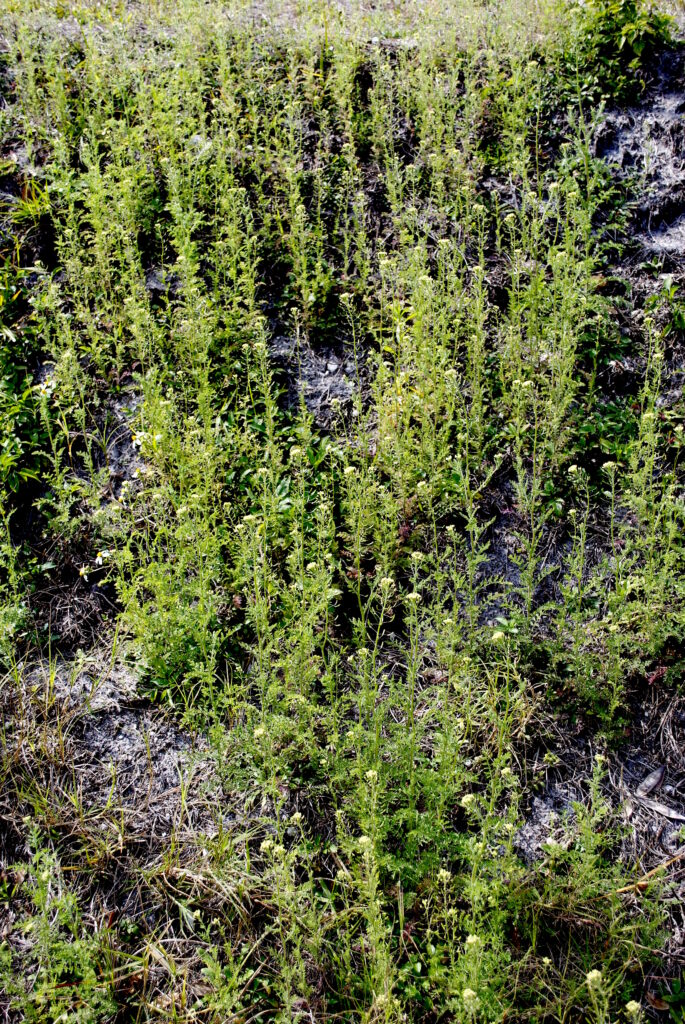
Post #91 Plant Profile: Peppergrass (Lepidium virginicum)
Much like oxalis, which we covered in our last Plant Profile, peppergrass is a native plant that is considered by and large to be an obnoxious weed. Here at South Florida Forest Gardening, we speak for the underdogs just as much as we parade around the beauty of the finest edible perennial ornamentals.
We like to look for this one as soon as the weather gets cool, though before it flowers it may be hard to identify. It’s good to learn what the plant looks like when it’s young because the flavor is mild and you may rather harvest it at this stage. As the plant gets older the peppery flavor that gives it its common name becomes stronger. It really just comes down to a taste preference.
Once it flowers, this plant is easy to recognize. It is considered a weed that must be vigilantly eradicated because it spreads via reseeding, but that would depend on what it’s doing in your yard. Once you acquire a taste for it, you may seek it out in the fall!
Beyond our own consumption, peppergrass is a larval food for butterflies including but not limited to the cabbage white butterfly, great southern white butterfly, checkered white butterfly, and falcate orange tip butterfly. This is another reason to let some go to seed for next year.
How do you eat peppergrass?
A member of the mustard family, the leaves taste peppery, like strong mustard. They are good raw in salads. The leaves are not really large enough to use for cooking, unless you happen to find a lot of it and just throw any extra handful into a pot of greens you already have going.
The seeds can be dried and used much like black pepper. In fact, another common name for this plant is “poor man’s pepper”. Harvest the seeds when they are still green by stripping them off the stalk. Try using the whole seeds in a stock you plan on straining for an added flavor boost.
The flowers are tiny, but sprigs of the flowering plant impart a beautiful touch as a garnish to any meal and a peppery bite if eaten. They look so pretty alongside a fish dish.
How do you grow peppergrass?
In South Florida, peppergrass practically grows itself. The bigger question is, how do you keep it under control? The answer is easy, harvest the whole plant when harvesting for food. Just be sure you leave a patch to go to seed so you’ll have a plentiful bounty to return to year after year.
If it does not currently reside in your yard but you’d like it to, take a walk through your neighborhood. It grows mainly in wild or disturbed areas, such as fields and vacant lots. It is a true pioneer plant, which grows just fine in poor soil like our fine white sand.
Check out open spaces and your neighbors’ yards and you’ll most likely stumble upon a patch. With permission, dig up a clump to transplant. Just be sure it hasn’t gone to seed yet. Leave this clump to drop seeds for next year, and refrain from harvesting until you’ve got a nice, healthy patch going.
Remember, as a general rule, source foraged foods from at least 25 feet away from any road because of pollution from vehicles.
To grow this spicy native on purpose directly from harvested seed, collect seed at the end of the cool season. Simply cut a bunch of dried flower heads, place in a paper bag, and shake really well. The seeds will come loose, gathering in the bottom of the bag. Or roll the flower heads in your hands over a paper towel. Go forth and plant at the start of the cool season!
Can you find peppergrass for sale?
We’ve never seen it harvested for sale as fresh produce, but we wouldn’t put it past our local South Florida farmer’s market vendors to throw it on the table. It’s a cool weather crop, so take a look around when it’s in season.
Otherwise, rely on transplanting a clump or collecting seeds as we mentioned earlier. Seeds are also available online if needed.
Note: Do not confuse Lepidium viginicum with the perennial Lepidium latifolium, which doesn’t grow here to our knowledge. Although Lepidium latifolium is also edible, it is not native.
The humble peppergrass plant has been given official recognition as a native wildflower, solidifying its place in Florida’s landscape.
Often it doesn’t even show up in my yard, but I find it in empty lots while out walking. No one seems to mind if I harvest some to use for my dinner. I’ve chosen to let it be a wild-harvested seasoning for me. I’ve got plenty of other native species growing in my forest garden.
Sometimes I think it’s better to view the entire world as a garden for us to collectively tend. A garden from which we can harvest and share, beyond our yards and fences.
So… Do you have peppergrass growing in your yard? Does your neighbor? Does the alleyway or an empty lot up your street host this native? Post your pictures, thoughts, ideas and more in the comments below. Let’s share!
Until Next time,
Happy Gardening,
Mary