
Post #3: Chaya
Blog Description: Chaya (Cnidoscolus chayamansa), Zone 10 south Florida gardening for food, subtropical, permaculture, forest gardening, sustainable gardening, perennial, edible plant
If I were to recommend only one edible perennial plant for everyone to grow, it would be Chaya. Of course, I recommend many plants, I love plants! But seriously, if you were to grow one plant outside your kitchen door, this is the one you want.
When a friend gave me a cutting of chaya around twenty-five years ago, I could not have known it would become one of our most important staples. It turns out that chaya is far more nutritious than spinach, and grows easily all year long, with no effort beyond cutting the branches for its leaves. I can barely get spinach to grow at all here, and only in the coolest weather, which as we all know is a pretty short season.
Like other Euphorbias, Chaya (Cnidoscolus aconitifolius) is resistant to heat and drought, and has a milky sap. It is also a reliable and highly nutritious food source. So much so that humanitarian aid agencies recommend cultivating this plant in parts of Asia, Africa, and Central America where impoverished communities are being supported to plant home gardens for food security.
The best part? Its nutrition profile is off the charts! Compared with spinach it is superior in virtually every nutrient value, from vitamins A and C to essential minerals like calcium and iron. It is also a fantastic plant based source of protein, with up to 7.4 bioavailable grams of protein per 100 grams of cooked leaves. Check out this chart comparing chaya to spinach:
Chaya Nutritional Comparison to Spinach
Per 100g of fresh weight. Percentages are based on minimum daily requirements.

z Data for spinach obtained from the USDA (1984). y Average nutritive value according to Grubben empirical formula (1978). From: Kuti, J.O. and E.S. Torres. 1996. Potential nutritional and health benefits of tree spinach. p. 516-520. In: J. Janick (ed.), Progress in new crops. ASHS Press, Arlington, VA. Source: https://people.umass.edu/psoil370/Syllabus-files/Chaya.pdf
Chaya leaves can be eaten like any cooking green, but only after being boiled for a minimum of 5 minutes to destroy the cyanide, a naturally occurring element that is toxic to humans. I chop and boil them for 15 minutes for the tastiest result with the best texture. Only once this is done can you use them in stir fry or baked dishes, as simple baking or frying does not do a good job of removing the toxin.
A quick note on cyanide if it freaks you out: To put it in perspective, broccoli also contains cyanide in smaller quantities (which is why it is still safe to eat raw). Many of the plants we eat have poisonous parts. For example, tomato and potato leaves will make you very sick if you eat them. For each plant, it’s a matter of knowing what part to eat and how to prepare it.
As you may have gathered, chaya is by far my favorite perennial food plant. It is pest resistant, super easy to grow, and easy to harvest every day of the year once established. It’s not messy in any way and does not attract vermin. What’s not to love?
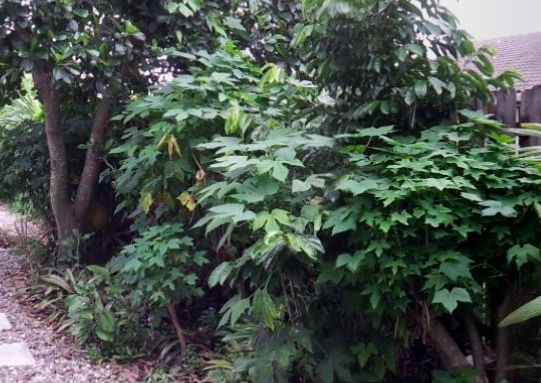
And get this, it is an attractive plant! You all know how much I adore a plant that is both functional AND beautiful. It’s the best of both worlds, naturally. It can be grown as a stand alone shrub, a functional hedge, or you can even let it go wild and grow to a 20 foot tall tree. A common nickname is “tree spinach”. For use as an edible, however, I like to trim it down to a bushy height of 3-4 feet.
Common cultivars include Estrella, Picuda, Chayamansa, and Redonda. Some cultivars have stinging hairs on their leaves, not unlike nettles, thus requiring gloves to harvest. Some claim these cultivars have better flavor, and not to worry, just like nettles the sting is neutralized by boiling. I grow a hairless kind.
Are you ready to plant some chaya yet? You certainly won’t regret it.
Plant It
Plant in the warm season.
Chaya grows well from cuttings, so if you have a friend or neighbor or a garden group you can procure some from, go for it. Ideally the cuttings should be around 12 inches long and cut from the woody part of the stem.
Once you’ve got some cuttings, air dry them in a shady spot for a few days to seal off the cut end. This will minimize the threat of rot. When they are ready, stick the cuttings in the ground, water deeply, and watch it grow. Yes, it is really that simple.
If you are in hardiness Zone 10 you may also find the cuttings already rooted and potted at a local nursery. In this case, simply transplant them into the prepared garden bed.
Grow it
A new chaya plant will take several months to really settle in, and for the first couple of cool seasons it may sit and not grow, resuming growth in the warm season. But after that, it will grow all year.
Although fairly hands off, regular watering, especially for the first year, promotes vigorous leaf growth. Since chaya is drought tolerant, you can go for periods of time without watering, but if you are growing the plant for food give it a regular drink. Consistently moist soil produces the best (and tastiest) results.
Chaya can grow in poor or sandy soil if that’s what you’ve got to work with, but if you can, do your baby plants a solid by side dressing with some organic compost or aged manure. The plants will thrive on it and the leaves will become more nutrient-dense.
Harvest it
Pruning and harvesting are the same action. Cut back a few branches so the plant looks good, and strip off the leaves to cook. A well established plant can be harvested year round.
A hard harvest of 50% of the plant can be done every few months once established, or you can harvest a smaller, meal sized portion of leaves several times per month or even week. Never cut back more than 50% of the plant and you should have a happy, healthy plant for years to come.
Prepare It:
Chop the leaves the same way you would kale or collard greens. Chaya is easier because there are no thick leaf ribs to remove. Boil for 15 minutes and drain the water. Reserve the cooking water and drink as a tea for a nutritious vitamin C boost, or let it cool and use it to water house plants.
Once boiled, use it like any cooked green. Saute it with whatever seasonings you like. Unlike kale, chaya doesn’t have a strong flavor, so is easy to incorporate into any recipe. Add it to lasagna to make the dish more nutritious. Or try mixing it with meat and seasonings for tacos, burritos, or tamales. Use it in stir fries or add to scrambled eggs. It is incredibly versatile with its pleasant texture and mild taste.
Here is a recipe I love: Chaya and Hibiscus Greens
Profile:
Common Name: Chaya, Chayamansa
Latin Name: Cnidoscolus aconitifolius
Family: Euphorbiaceae
Zones: 8-11
Exposure: part shade
Soil: well drained, sandy to rich in organic matter
pH: 5.5 – 6.5 is ideal, but it can tolerate a bit more neutral or acidic (outside range: 4.5 – 7.5)
Water: consistent, keep moist
Fertilize: regularly
Drought Tolerance: moderate
I hope you find this post on chaya helpful and informative, and would be be especially interested to know if you try your hand at growing it. Please share your thoughts and experiences and I will try to incorporate them here. The more we share our insights, the more we learn and the more we grow.
Happy gardening!
Mary