
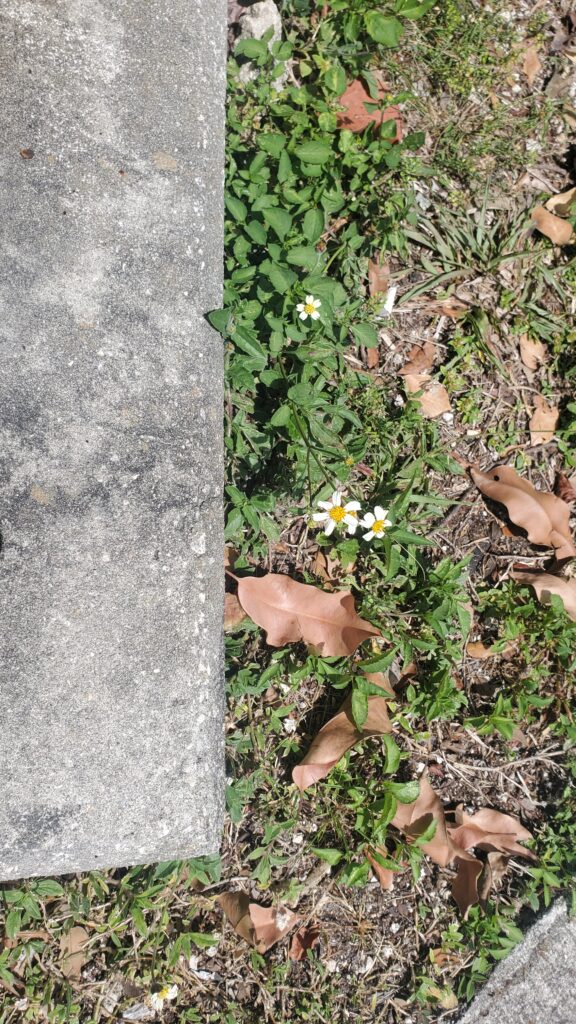
Post #77 Plant Profile: Spanish Needle (Bidens alba)
This weedy wonder takes us deeper into the herbal world of edible perennials. As Hippocrates touted, “Let food be thy medicine”. Spanish Needle is a perfect example of a food that grows prolifically all around us in South Florida and provides medicinal value to our meals.
A fun fact about edible, wild plants is that they are often more nutrient dense than their cultivated counterparts. These plants choose where they thrive based on the nutrients available in the soil. The plants then uptake those nutrients into their edible parts and, in turn, nourish the forager, whether it is us humans or other animals.
Spanish Needle is widely known as a nutrient rich supplement for chickens, goats, pigs, and other livestock. So if you don’t want to eat it directly, feed it to your animals and reap the benefits. We suggest trying it out in your own kitchen though, you won’t be sorry.
Bidens alba vs. Bidens pilosa
We are dedicating this post to the “true” Spanish Needle and most edible variety, Bidens alba, so let’s clear up any confusion between the two right here and now. Although upon first glance they appear quite similar in appearance and use, they are actually two separate species.
Bidens Alba is larger than Bidens pilosa and far superior to eat. Bidens alba is a Florida native, while Bidens pilosa was introduced to our area from Central and South America. Bidens alba shoots upright and boasts an attractive edible flower with white petals and smooth leaves while Bidens pilosa grows prostrate with fuzzy leaves and tends to produce a petalless flower.
If you encounter Bidens pilosa in your yard, we suggest pulling it for the most part unless it is one of your only pollinators. Bidens alba is so much more useful and equal in attracting pollinators to boot.
Wildlife Corner
Spanish Needle is a pollinator rockstar in the garden. It produces a huge amount of nectar for our pollinating helpers, specifically native bees and butterflies.
So even if you decide it’s not your favorite green to consume, consider leaving a patch at the back of your garden anyways to fuel the pollinators that may very well fuel the growth of your favorite garden vegetables.
How do you eat Spanish Needle?
HIgh in magnesium, folate and carotenes, Spanish Needle is a very nutritious addition to your plate. It is also rich in fiber and protein.
Use the young green herb and flowers in salads, teas, saute or steam, add to soups or use as you would any other cooking green such as chard or spinach. Both the leaves and flowers can be used as garnishes to fine dishes. Remove the tender leaves from the fibrous stem when eating raw or presenting as a garnish.
Note: This plant is high in a group of plant compounds called saponins which can cause digestive upset when eaten raw in quantity. Add small amounts to salad mixes if you are sensitive to it, or just simply prepare it as a cooked green instead.
How do you grow Spanish Needle?
The plant is aptly named for two needle-like points on the end of the seeds that stick themselves to everything. So you and all of the wildlife around you become the spreaders of the seed on clothes and in fur and other wildlife coats.
Spanish Needle plants itself. Each plant produces hundreds of seeds, it is true to its weedy nature in that way. This is one of those plants we suggest embracing if you’ve got it, but no need to set seeds if you don’t. Its seeds may eventually hitchhike its way into your garden anyways, and now you will know exactly what it is when it pops up!
If you’ve got it growing in your yard, pull up young shoots by the root for eating, leaving a small patch for the pollinators. A small patch will self seed heartily for a new bounty next season.
Where can you find Spanish Needle for sale?
It might show up in season at a local farmer’s market, but it’s doubtful you would find it as a fresh herb anywhere else. You might sooner see it as a medicine, in tincture form or as a dried herb in a tea blend.
Although this is a forest gardening blog and not an herbal medicine blog, we would be remiss to skip over this herb’s extensive folk medicine history up through present day. Spanish needle is used for all sorts of ailments from high blood pressure to inflammatory discomforts. It is used topically for sore gums and skinned knees alike. Given its antibacterial and antiviral properties, a tincture or fire cider can be kept on hand for winter ailments.
Do you have Spanish Needle growing in your yard? If so, do you harvest it for your kitchen or medicine cabinet? How do you use it? I like to throw a few leaves in our dinner salads. I often munch on a flower here or there as I work in the garden. Sometimes I add the leaves to soups; I find this a good way to preserve it past the season. I pull out a batch of frozen soup for midwinter ailments, chock full of medicinal greens including Spanish Needle, and we feel the medicine working through our food.
Share with us how you use this fantastic weed in the comments below. Or ask us questions and we’ll get back to you with answers!
Until Next time,
Happy Gardening,
Mary