
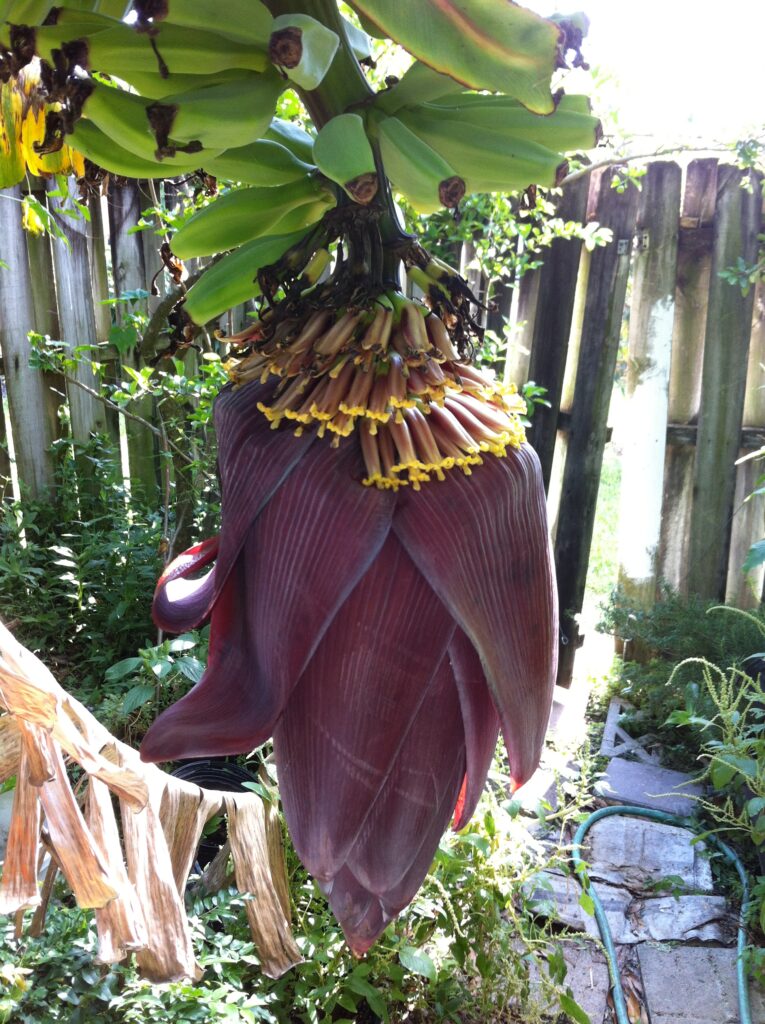
Post #76 Plant Profile: Bananas and Plantains (Musa spp.)
Bananas are a wonderful fruit that need no introduction. Plantains are a slightly lesser known fruit within the continental United States, but commonly grown and eaten in our South Florida climate.
Although we are largely accustomed to the prolific and widely exported Cavendish banana variety, there are so many varieties to try!
The biggest advantage to growing your own banana and/or plantain grove for local consumption (think, your kitchen!) is that when you don’t have to worry about shipping them you can grow so many more diverse flavors.
Like tomatoes, when grown in your own backyard, the flavors are night and day to those bought at the supermarket. You can choose varieties with thinner skins and more delicate flavors that are coaxed out through the natural ripening process. Banana varieties grown for export are picked very green and gassed to encourage ripening.
Banana vs. Plantain: What’s the Difference?
They are both high in potassium and contain significant quantities of magnesium and vitamin C. High in fiber and pre-biotics (food for probiotics, beneficial bacteria for your gut), they are helpful for the digestive system. They look and smell similar, so what’s the difference?
While they boast many similarities and come from the same plant family, bananas and plantains are different fruits. A close look will prove plantains to be larger and firmer with a thicker skin than bananas.
Bananas are higher in sugar, while plantains are higher in starch. This makes the banana a more obvious choice to eat raw and to use in cooked desserts. Plantains are better digested and just taste better when consumed cooked, and often in savory dishes.
Ornamentals
These plants are not always grown for their delicious fruits. In fact, there are many varieties that are grown right here in South Florida as ornamentals.
Ornamental varieties range in color, fruit and flower shapes, and of course, size. They can be grown as shade screens in an otherwise hot and sunny yard. They can take up space when you want to shrink your lawn and add color and texture to your landscape. They are so pretty swaying in the breeze and their presentation is quintessentially tropical.
We’ll dig deeper into specific ornamental banana and plantain varieties in a separate post. They deserve a spotlight all their own!
How do you eat Bananas and Plantains?
- Bananas – raw, in smoothies, baked goods (pies, breads, muffins, cakes, and more), fruit salads, pancakes, puddings, and parfaits. Green bananas, depending on the variety, are sometimes eaten in more savory dishes like a green plantain would.
- Plantains – smashed and fried, thinly sliced and twice fried (tostones), sliced and baked, simmered or grilled in savory dishes.
- Green through very mature yellow to almost black skinned overripe plantains are somewhat interchangeable depending on how you want the dish to turn out.
- There are some recipes, such as plantain tortillas, that call for a specific ripeness. In this case, it would be green and underripe.
- Overripe plantains are less firm and tend to be a bit sticky, so they can be tricky to fry. Always use a high temperature cooking oil such as avocado oil and get the pan and oil hot (shimmering but not smoking) before frying for best results.
- Leaves – the leaves can be used to wrap food for steaming or baking. Young leaves that are still developing inside the pseudostem (trunk) are tender and can be eaten raw or cooked.
- Flowers – the flowers are edible as well, boiled or steamed. They are harvested once the main bunch of fruit has formed and is sizing up. The soft parts near the bases of the flower bracts are eaten like those of Globe Artichokes.
How do you grow Bananas and Plantains?
The most common and easiest way to plant them is from the sucker, or “pup” of a mother plant. That is, the off-shooting new growth of a mature plant. The pup will transplant easily.
Bananas and Plantains are water lovers and fairly heavy feeders. One way to plant them is in a circle around a dug out pit. Drop kitchen waste and mulch into the pit regularly to feed the plants. Do this in a fairly sunny, low wet spot. They prefer full sun but can handle somewhat partial sun. If you have an outside sink, direct the drain pipe or hose to empty into the pit or around the base of the trees. They like wet feet.
They also appreciate protection from strong winds that otherwise tatter the leaves. The plants bear all year except in winter.
There are many varieties to choose from. Some grow quite tall, others cap out at around 6 feet. Consider the area you have available to grow a small grove, then decide on the variety and quantity that will suit your space.
The quick and dirty planting guide:
- Dig a hole about 24 inches deep and 36 inches wide.
- Place the pup in the hole and backfill the hole with well draining, rich soil.
- Surround the newly planted pup with a ring of mulch about 4-6 inches deep to help retain moisture.
- Fertilize regularly with kitchen waste, compost, and/or a potassium-rich, organic liquid fertilizer.
Tip: plant pups about 5 feet apart from each other using a circular or block pattern to create a grove of trees. They do best this way as they naturally block the wind for each other.
How do you harvest Bananas and Plantains?
Their fruit grows in bunches on a single stalk, often referred to as a “rack”. Each bunch will consist of up to 200 bananas. So be ready to process these fruits when they are ready!
Cut the stalk off of the tree when the top of the bunch just begins to turn yellow, then hang in a warm, dry spot such as a covered porch, to finish ripening. The fruits will ripen over the next several days, so check them each morning, harvesting the ones that are ready to eat. Or harvest the green fruits for savory dishes and for cooking in general..
Once a stem (tree) has fruited, it will die, so you may as well cut it down when you harvest the fruit stalk. Usually at least one baby plant will already be coming up next to the old one. If you can, chop up the old stem (trunk) and toss the pieces in the center pit if you created one. Otherwise, lay it down in the back of one of your beds to feed the soil as it slowly becomes compost.
Where can you find Bananas and Plantains for sale?
Bananas are ubiquitous. Find them at roadside stands, convenience stores, and all grocery stores. Plantains are commonplace in our climate as well.
If you are considering what varieties to grow, check out local farmer’s markets to see what’s growing well in your area. Buy a few different varieties and be sure to write down the names of each. Try them out and decide which ones you enjoy enough to grow in your yard.
Then check out local plant nurseries or even neighbor’s yards to find the varieties you want. Offer to buy some suckers from a neighbor – you may get lucky and score some free of charge. Or maybe you have some plant cuttings you can trade.
Ask the people running booths at the farmer’s market too, they may be willing to bring some pups in for you on the next market day.
Hopefully this post has been helpful in explaining the similarities and differences between bananas and plantains, and how to grow and eat them accordingly.
I grow several bananas and one type of plantain. Unfortunately, I don’t know the names of any of the varieties I have – they were all gifted to me. I’m sure with a little investigation I can figure out what they are though.
As time allows, we may do some posts on individual varieties, as there are so many to learn about. Let us know your thoughts on this. Are there any varieties in particular you absolutely love? Either as an ornamental or an outstanding tasting fruit? Or both? What individual varieties would you like to see posts on?
Share your thoughts in the comments below, we love hearing from you!
Until Next time,
Happy Gardening,
Mary