
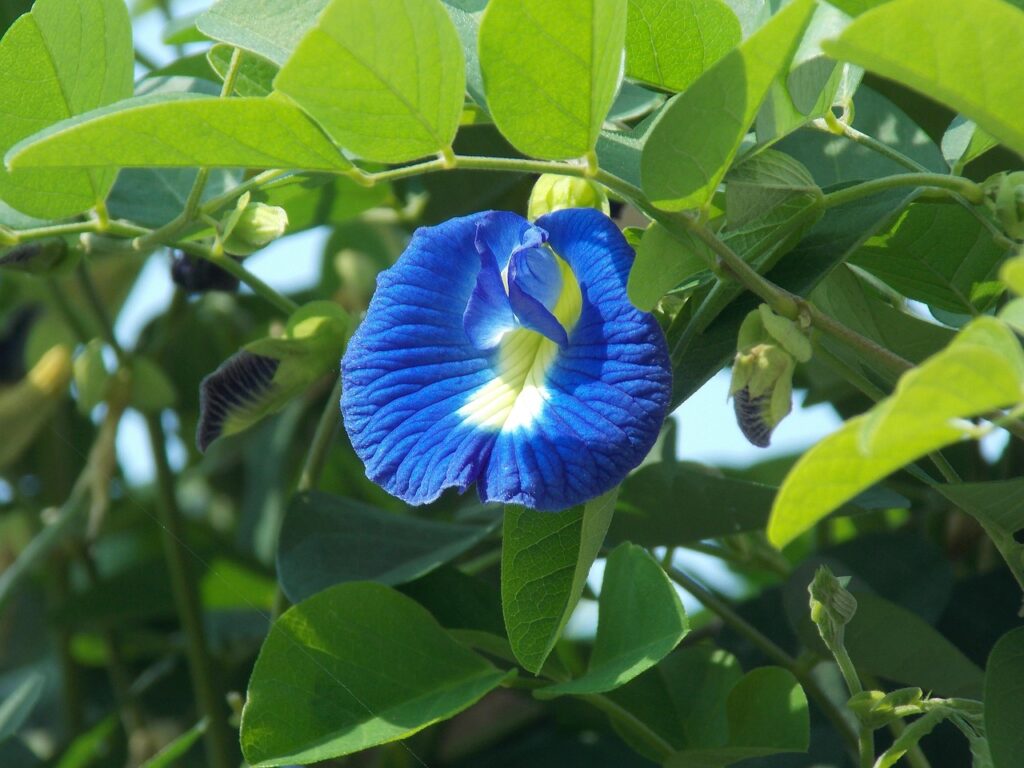
Post #87 Plant Profile: Butterfly Pea (Clitoria ternatea)
Ah, the butterfly pea! This gorgeous vining pea plant is as much ornamental as it is edible. Its deep purple to cobalt blue blooms and medium green leaves adorn a twining vine that can fill in a trellis or hang from a basket beautifully.
If you plan to let the pea pods mature for food, a trellis offers much more support. If your aim is to collect the edible flowers, a basket does the trick.
Native to Africa, the butterfly pea has become naturalized across India, Central America and much of the Southeastern United States. It is happy wherever there are hot, humid conditions, perfect for our neck of the woods.
Attractive to humans and pollinators alike, this plant provides abundant food for all! If you are looking to add more pollinator plants to your forest garden, the butterfly pea is a worthy addition.
As a legume, an added bonus for your garden is that it fixes nitrogen in the soil if the right mycorrhizae are present. It doesn’t have many pest or disease problems, making it an easy keeper to boot!
Nutrition HIghlights for Beauty Inside and Out!
The flowers, brewed as a tea, are known for the following:
- Hair Health – a common ingredient in hair products, butterfly pea deeply nourishes hair follicles to encourage growth.
- Rich in Antioxidants – Among the many other reasons we love a good dose of antioxidants, butterfly pea has an affinity for skin health.
- Anti-inflammatory – Reduces swelling in the body, including puffiness around the eyes and face in general.
- Stress Reduction – Brew up a cup to calm the nerves. Everyone feels and looks better when stress melts away.
How do you eat Butterfly Pea?
The flowers are most commonly brewed in tea. The blue color imparts itself into the water for an infusion that is pleasing to the eyes. Even more fascinating is that changing the pH will cause more color changes. Add in a bit of lemon juice or tonic water for a leap to pink hues. Add in some roselle powder for a deeper magenta!
The flowers are commonly dipped in butter or battered and fried in parts of Asia. They are also used as edible garnishes to salads and desserts. Their flavor when raw is mild and slightly sweet.
The peas are not quite as popular, but they are edible and can be dried and ground as a protein source, eaten raw, or added to any recipe you would use peas in.
The roots are used in Ayurvedic medicine for several purposes. The flowers and leaves can both be used as natural dyes.
How do you grow Butterfly Pea?
This is a very manageable vine with gorgeous edible flowers, which may have a single or a double form. The double form is easy to find and has a second set of petals in the center, so it’s more showy. In addition to the deep blue-purple varieties, there are light blue and white varieties as well.
Generally grown as an annual or biennial (short lived perennial), butterfly pea is easily grown from seed. Direct sow in prepared soil, in full sun, for an easy keeping pea vine. Keep it regularly watered and it should grow readily for you.
Pro Tip: Nick or file the seeds, then soak overnight in water before planting for a higher rate of germination. Germination can take up to 2 weeks.
It can also be grown from cuttings, if desired. To grow from a cutting, take a 4-6 inch length of vine, strip the bottom leaves, and place in moist sand. Keep the sand damp but not swimming until the vine roots, then transfer to a prepared bed or container. This may take a couple of weeks.
Given its vining nature, much like its relative, sweet peas, it needs a trellis or support to climb up. When provided ample space and satisfactory conditions, it can vine up to 15 feet long and spread out up to 6 feet.
Harvest
Harvest the flowers at their peak of color. The vines will begin to bloom 4-6 weeks after planting from seed.
Harvest peas to eat when they are mature with big, bright green pods with fully developed peas inside. Harvest peas for seed once the vines have begun to die back and the pods are dried out.
Where can you find Butterfly Pea for sale?
It is important to note that other plants that cannot be eaten are sometimes also called Butterfly Pea, so be sure of the species when choosing this pea plant.
You can usually find butterfly pea at the local nurseries here in South Florida, as it is quite common. Once you have an established plant or two, let one go to seed and collect the dried seed pods. Store the dried peas in a cool, dark place until you are ready to propagate more plants. Otherwise, many companies sell seeds online.
We love all the plants we showcase in our plant profiles, that’s why we pick them! But I must say, the butterfly pea is really a star. From its quick growing vines and showy flowers to its versatility as an ornamental AND an edible, its a showstopper.
Suitable for the front garden on a small trellis, I like to use a cone-shaped trellis in a large pot so it looks a little like a topiary. This way it can be moved around in sunny spots, or removed when it dies down. Keep in mind that the vine must be in full sun to produce flowers.
Since the leaves are medium green, the plant might look nice in the garden next to a shrub with reddish foliage, such as a Copperleaf or a Razzleberry. Or place it in a pot to one side of a gate or door, or with a wall as a backdrop. These are some of the ways I have integrated this pretty vine into my garden.
Do you grow butterfly pea in your garden? Or any sort of pea plant as an ornamental edible? Share with us in the comments section below, we love hearing from you!
Until Next time,
Happy Gardening,
Mary