
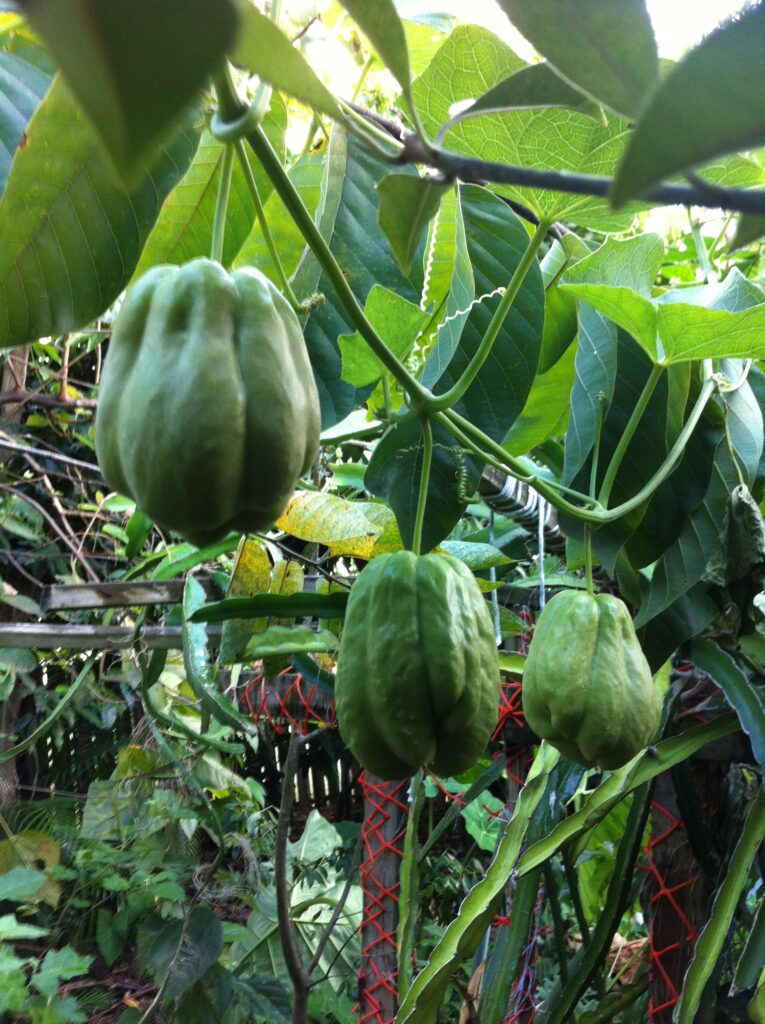
Post #82 Plant Profile: Chayote (Sechium edule)
If you’ve ever tried growing zucchini or summer squash here in South Florida, you know it can be tricky. The weather is not particularly conducive and the yields, if any, are surprisingly small considering the way it grows like a weed up North.
Fear not, we have a subtropical solution to your zucchini woes…Chayote! Also commonly called vegetable pear, mango squash, and mirliton, it is native to Mexico and Guatemala and can stand up to the heat and humidity of our steamy summers.
Best of all, unlike some of its relatives, chayote is a perennial! Once established, it will come back year after year, with its best yields during its second and third year.
HIghly nutritious and an easy grower in our climate, this fruit bearing vine makes a productive addition to any forest garden.
How do you eat Chayote?
Hailing from the same family as pumpkins, melons, and cucumbers, chayote has a mild, crisp flavor reminiscent of a cucumber crossed with a zucchini. Its flesh is a bit denser and very crisp. Although botanically classified as a fruit, the gourd is often eaten like a vegetable.
Although the gourd is what we think of when we think of chayote, the whole plant is edible. The vine tips are commonly used in stir fries in Asian dishes, and the seed and tuberous root can be eaten as well.
You can substitute chayote in any recipe that calls for zucchini, one of the many reasons we love this vegetable fruit! Just like zucchini, it can be eaten raw as well as cooked. We might even venture to say we like raw chayote better than raw zucchini due to its extra crispness.
Try it grated in a raw vegetable slaw with carrots. Serve it on a crudite platter with other vegetables and a dip. Chop it up any throw it in a hearty salad such as a cobb salad. Add it to salsas. It also makes a great pickled vegetable, throw it in a mix with carrots and cauliflower for a twist on an escabeche (Mexican pickled vegetables).
Cube it and add it to soups and stews to boost nutrition. Throw it in a stir fry, try it skewered on the grill. Toss it with root vegetables and roast them on a sheet pan. Mash it. Or try a savory spin on the fruit, mix with pears or apples and cinnamon for sauces, pies, or crisps.
Chayote’s mild flavor and pleasant texture lends itself to immense versatility in the kitchen.
A note on the skin:
The younger a chayote is, the thinner the skin. We don’t bother peeling them unless it is an older fruit, almost ready to sprout. These are still quite edible, but the skin is thick and tough, making it unpleasant to eat.
The more mature, thick skinned chayote is great for storing, the skin keeps them fresh for up to 4 weeks when stored in the refrigerator. And when it comes time to peel and eat the fruit, the peels add great nutrients to your compost!
Another way to preserve the fruit is to peel it, chop it and freeze it.
Nutritional Benefits – or 5 Reasons to Love Chayote!
Speaking of nutrients, chayote is chock full of micro- and macronutrients. With its light flavor it is an innocent addition to meals and desserts for those who are not big fans of produce.
- Rich in Fiber – a great source of fiber to help lower cholesterol, keep you regular, and feed the good bacteria in your gut.
- Source of Folate – when people mention that chayote is good for pregnant women, this is why. Folate, or B6 is an essential vitamin for fetal growth development and an overall healthy pregnancy.
- HIgh in Vitamin C – just one cup of chayote contains 14% of the recommended daily value. Vitamin C is a powerful antioxidant that supports many functions of the body, from the immune system to healthy, glowing skin.
- Mineral Rich – chayote draws minerals from the soil and is especially rich in copper and manganese. Copper supports iron production and manganese is essential for energy metabolism among other functions.
- Low in Calories – if you are watching your weight, consider bulking up your diet with chayote. You can sneak it into so many dishes to provide nutrition and fiber, which will provide a feeling of satiation in an otherwise smaller dish.
How do you grow Chayote?
Chayote is quite easy to grow once you get the hang of it. It is generally ready to harvest in the Fall here in South Florida. There are many varieties, but yu will most commonly see the Florida Green and the Monticello White available in South Florida. They both grow exceedingly well here.
Chayote is grown from the whole fruit. There is a single seed inside that will sprout the vine, but it is best to plant the whole fruit and let the seed organically sprout out of it rather than extract the seed.
Follow these guidelines for successful growing:
- Plant in full sun.
- Prepare soil in a bed or container no less than 5 gallons in size by combining aged manure or compost with a light, well draining potting mix.
- Dig a hole for the fruit and add some sand if you have it to help with drainage.
- Plant the fruit with just the tip of the narrow end poking out. If you experience chilly nights where you live, cover the top completely to keep it insulated until it sprouts.
- Construct a trellis for the vines to climb. In a larger garden you can use an arch, in a bucket of container simply create a climbing trellis with bamboo poles and string. Or, plant the fruit near a tree and train the vine up the tree.
- Water regularly until the plant is well established, then less frequently. During the summer months the rains we get may be enough to sustain it without supplemental water, but keep an eye on the vine.
- Create a potash by mixing ash with water and fertilize with this mixture evry so often to keep the pH balanced.
- Harvest fruits at maturity by snipping them off the vine and new shoots as you like to use as cooking greens.
Pesky Considerations
Chayote are prone to nematodes. To cut down on the possibility that nematodes will prevail, plant your chayote in containers. A 5 gallon bucket is the smallest we’d consider, but they will be more comfortable in say, a half barrel, especially if you plan to keep the vine as a perennial.
Where can you find chayote for sale?
Most markets have at least a few in a basket in the produce area these days. If you have no luck at your local supermarket, try a produce store or an Asian or Mexican market.
And of course, check your local farmer’s markets and neighbor’s backyards! Just make sure you ask permission before you go snipping the neighbor’s chayote, hey you might even make a new friend!
So, how do you like to eat your chayote? Share a quick recipe in the comments below. We love sharing ideas!
New to chayote? Try it in a salad or roasted on a sheet pan with some seasoning to get yourself acquainted with this lovely fruit. I think you’ll realize the advantages of adding it to your food forest pretty quickly.
Until Next time,
Happy Gardening,
Mary