
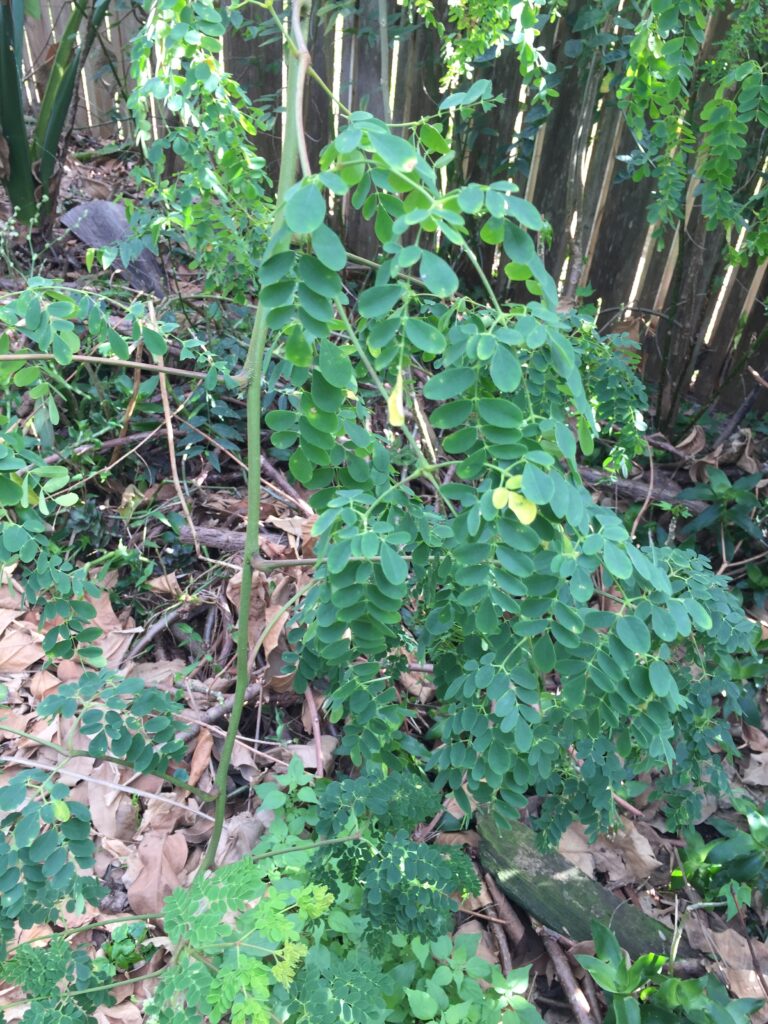
Post #66 Plant Profile: Moringa
Today we are putting the spotlight on another wonderfully nutrient-dense, edible tropical perennial you can easily grow in your South Florida zone 11a forest garden.
Moringa can grow to be a gorgeous tree with edible feathery leaves that sauté well. It can also be grown much like spinach, even in row crops, and harvested as a whole, young plant. Harvest the roots of the young plant as a great sub-tropical substitute for horseradish. This gives it the name Horseradish Tree in some cultures.
In many Permaculture landscapes, Moringa is grown close together in a row as a useful hedge, or “living fence”. This way, it serves two functions, first to separate areas, sometimes keeping animals in bounds, and second, for its useful leaves. More on that below.
If you let it become a small tree, it will produce pretty white flowers, which taste decidedly like radishes and make a nice tea. Leave it a bit longer, and it produces long pods, which is why people in India call it the Drumstick Tree.
As an addition to a forest garden, it offers light shade that is pleasant to sit under, and to grow some of your more delicate plants under as well. It is easy to remove young limbs to let more light into the canopy.
It grows very fast, so it produces a lot, but this also means it needs a lot of pruning to keep it in bounds. Pruning can also be called harvesting though, so that’s okay.
5 Reasons to Love Moringa for your Health
- High in protein, moringa leaf is often dried and made into a powder and added to soups, sauces, porridges, and baby food in West Africa and India. Here in the United States, it is becoming more commonly used as a protein powder in nutritional shakes.
- Taken during pregnancy and nursing, six rounded spoonfuls daily will meet a woman’s requirements for iron and calcium. In fact, it is reported to have 17 times more calcium than milk and 25 times more iron than spinach!
- Looking to introduce more potassium into your diet? Moringa boasts 15 times more potassium than bananas.
- Want to save money on multivitamins? Moringa contains a wide variety in significant quantities, and is particularly high in vitamins A and C.
- Moringa Leaf packs an antioxidant punch to protect your cells from oxidative damage and support the immune system.
How do you eat it?
Leaves
Harvest by cutting back the feathery branches, then strip them of the leaves and compost the stem or leftover branch. Use as you would any leafy green: sauté, or add to soups, stews, or stir frys. They are very good simply sautéed for just a few minutes, especially with butter and salt, and maybe a little onion.
To make a powder, dry the leaves out of direct sunlight to preserve nutrients. You can do this in your covered patio or carport. They will dry even faster inside in the air conditioning, since the air is drier. Being so small and thin, they will dry quickly without the need for a dehydrator. Crush into a powder (a blender is helpful but not necessary) and store in a dry, cool place. Use as a nutrient dense addition to sauces, porridges, nutritional shakes, or baby food.
It is a very low-tech protein powder you can make at home!
Flowers
Harvest in full bloom and lay out to dry or use fresh to make a refreshing, floral tasting tea.
Seed Pods
Harvest the young seed pods and eat them cooked whole. The taste is similar to fresh, young asparagus. Let the seed pod develop, shell the seeds, boil and use them as you would fresh peas.
What else is it useful for?
It has been well documented that moringa leaf is an effective treatment for malnourished children and nursing mothers. In fact, charitable organizations are introducing the plant throughout warm areas of the world because it is so easy to grow and doesn’t need equipment to process. Moringa is a life-saver in malnourished communities because its leaves contain significantly more protein than just about any other plant food, as well as vitamins and minerals.
It can be grown as green manure or as a nutrient dense fodder for livestock. It is a great chop and drop plant for composting in place.
The seeds are pressed for high quality cooking oil on a small scale.
The soft wood of the moringa tree does not make good firewood, but it does lend itself well to latticing, living fences or trellises.
How do you grow it?
The plant is drought-resistant and the soil doesn’t need to be good, but should be well-drained. If you have a sunny spot where nothing grows well, plant Moringa seeds or cuttings and stand back. There’s no need to improve the soil, and there are no pest problems.
You have a bunch of options depending on how much space you have and what you’re growing it for.
Option 1: Grow young plants in rows or tuck them into beds, and harvest them whole. Use the leaves as a spinach and the roots like horseradish, peeled and grated.
Option 2: Plant as an individual shrub or a living fence, and harvest leaves as needed. Let it grow to 6’ before cutting it back to 4’.
Option 3: Keep it as a small tree, topped out at around 8’ tall so you can reach the good stuff, which will hang down. This is how I use it. Sometimes I allow a fruiting or flowering vine to grow up the tree as a support, especially if the vine is an annual and not too heavy. Both tree and vine can be pruned at the same time.
Once established, a Moringa tree shouldn’t need water beyond natural rainfall. It can grow to 40’ tall if it’s happy, but the weak, soft wood can easily break in the wind, so do not plant near buildings if you plan to let it get large. In fact, I often spot-prune mine by breaking off branches if I’m not carrying my lopper at the moment.
Where can you find it for sale?
Good question! It grows readily from seed so if you can find a local source for seeds, go for it. If not, check out your local nurseries to see if they have any seedlings.
Someone in your local gardening club may have one, or you can mail-order seeds. Sometimes I have them available. Feel free to contact me.
If you see a friend or neighbor growing moringa, ask for a few cuttings, this is the easiest (and fastest) way to grow it. Just stick them in the ground, add water, and watch them grow!
Once you establish a tree of your own, use cuttings to make more plants. Or let the pods grow and set fully matured seeds; this will take up to 2 years.
Do you grow moringa? Or do you find it at your local markets and cook with it? Let’s talk recipes! Throw your ideas into the comments. We’ve been experimenting with green curries, stir frys, and sauces for grilled fish, yum! What is your favorite way to enjoy this superfood? You know we love hearing from you!
Until next time, Happy gardening!
Mary