
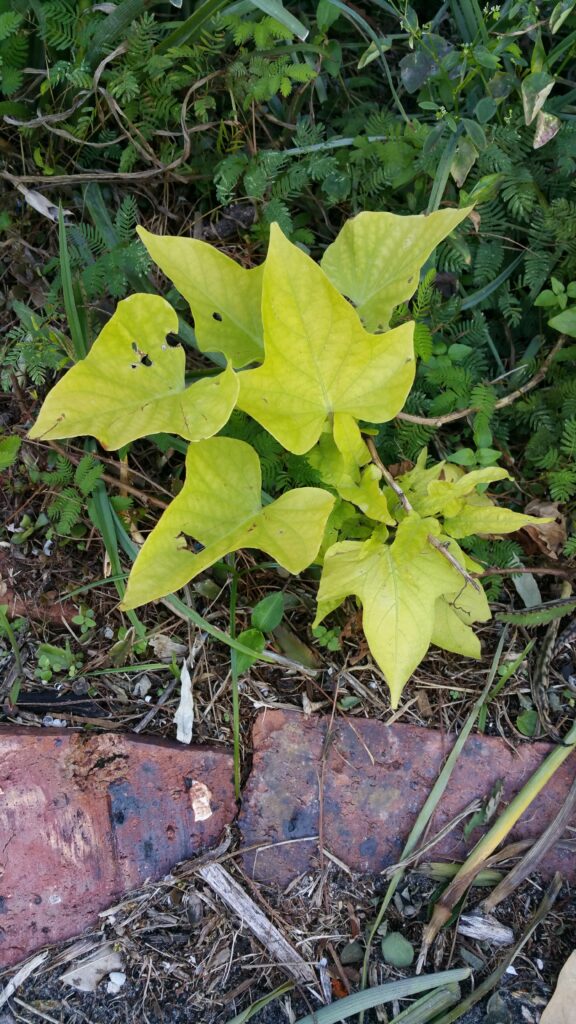
Post #68 Plant Profile: Sweet Potato
The humble sweet potato is South Florida’s answer to growing potatoes. Although it is a vastly different plant than the white potato, it provides a similar, starchy vegetable on the dinner plate or anytime of day really! Sweet potatoes are some of the best roots we can grow, and they are especially nutritious.
Our advice is to grow as many varieties as you can find. Packed with dense nutrition and super delicious, what’s not to love?!
5 Reasons to Adore Sweet Potatoes!
- Eye Health – just 1 cup of sweet potato contains 11.3 milligrams of beta-carotene, and the orange-fleshed varieties are packed with carotenoids, both antioxidants known to support vision.
- Supports Healthy Blood Pressure – rich in potassium sweet potatoes, when eaten regularly, can aid in blood pressure regulation in combination with other positive lifestyle factors.
- Cardiovascular Aid – packed with antioxidants and flavonoids that can exhibit anti-inflammatory effects, consumed regularly as part of a heart-healthy diet.
- Fights Cancer – Purple-fleshed sweet potatoes contain high levels of anthocyanin, an antioxidant which is also found in blueberries, and is known to support an anti-cancer diet.
- Rich in Fiber – can help to balance blood sugar and support overall health.
How do you eat them?
Sweet potatoes come in a rainbow of colors, and different varieties have different flavor profiles. Beyond the common tuber, the leaves of the potato vine make a great, edible cooked green as well.
- White fleshed varieties tend to be starchier, drier, and less sweet. Use these as you would white potatoes.
- Purple fleshed varieties also tend to be less sweet and look beautiful in potato salads or really in any showy dish.
- Orange fleshed varieties are quite sweet and make a great carrot substitute when eaten raw, or used as a substitute for pumpkin when cooked as their flesh is very moist.
All sweet potatoes can be sliced and made into tasty french fries by either tossing with oil and baking in the oven, air-frying, or using the traditional fryer method.
If you like the greens, grow a couple plants just for that purpose. If you regularly harvest the greens, the plant will focus its energy on the leaves and not the tubers (which will remain small). The ‘Boniato’ variety has some of the best tasting leaves.
How do you grow Sweet Potatoes?
First, they must sprout. Either leave them on your kitchen counter and let them do their thing, or take a couple of toothpicks, piece the tuber on either side, and dangle in water. This may speed up the process. We’ve tried it both ways and they both work just fine.
- Whole, sprouted tubers can be planted shallowly any time of year, but they will do better in warm weather.
- Tubers can also be cut into pieces, each with at least one tiny sprout. Let the cut pieces dry for a few days out of the sun before planting.
- One-foot cuttings or leafy sprouts can be snapped off, rooted in water, and planted 2’ apart.
Add some compost or other organic matter before planting. See the note on nematodes below.
Left to themselves, the vines will run on the ground, rooting at nodes, and all those small roots will use energy. However, if the vines are made to grow up on a trellis or hang down from a large container, the plants will be forced to put more energy into the first set of roots. This will make the tubers grow larger, faster.
Self-watering containers are ideal for intensive production of sweet potatoes.
If you don’t want to bother trellising, just walk away, and know that it may take longer than four or five months to get good-sized roots. They will often bulge out of the ground a little bit or be sitting just under the surface.
You can use the soil as your storage system. Tubers can sit in the ground for weeks or months until needed, getting larger all that time.
Pesky Considerations
Foliar Pests – those that attack the leaves include silverleaf whitefly, leaf-miner larvae, and armyworms. Use a natural pesticide directly on the leaves if needed.
Pests that Attack the tuber or Root – sweet potato weevil, wireworms, banded cucumber beetle, pale-striped and sweet potato flea beatles, diaprepes root weevil, and Cuban May beetle. To avoid these pests, do your best not to introduce them to the soil by purchasing certified slips or transplants. When choosing tubers at the store, check for any signs of damage.
Nematodes – will attack both roots and leaves. The root-knot and sting nematodes are most common in our area. They are microscopic so the best way to be sure your soil is safe before planting is to collect a sample and have it tested. Nematodes love sand and they hate organic matter, so you can make your soil inhospitable to them by continually adding compost and mulch to the surface, which the friendly soil critters will pull down and decompose for you.
If you are noticing mid-season that plants are dying slowly and haphazardly around your garden, suspect nematodes, but there’s not much you can do to save those particular plants at that point. So amend your soil before planting.
To keep soil pests from becoming a problem, rotate where you plant each year. Try switching your sweet potato and longevity spinach patches for example.
Nip Weeds in the Bud EARLY!
Sweet potatoes are a long season crop, so weeds can get out of control over time if they are not properly managed. This creates a competitive environment for the tubers that are working hard to draw nutrients and swell under the soil.
Begin with a weed-free garden space and regularly pull any weeds trying to grow around the plants. Vigorous sweet potato vines will shade many out. Also, keep mulching, and don’t worry about keeping the mulch away from the stems.
Where can you find sweet potatoes for sale?
Start at the grocery store, preferably with organic roots, since GMO sweet potatoes are now being developed. Then go to your local Asian market and pick up any you see there.
Some exciting varieties to try are the purple-fleshed ‘Murasaki Purple’, and ‘Solomon Purple’, which has purple leaf stems and ribs and is actually bright pink inside.
For ornamental value, try ‘Blackie’, which has beautiful deep purple leaves, or ‘Margarita’ with lime-green ones. Both are sold as ornamentals at garden centers and produce tasty white roots. No one has to know your gorgeous groundcovers are moonlighting on your dinner table!
What are your favorite varieties and preparations? We like slicing cold baked sweet potatoes into our summer salads. They are also a great side diced and tossed with oil and salt, then roasted. Whip up some nutritious baby food by mashing cooked orange-fleshed sweet potato. This is also a good nutritional boost for anyone on a soft food diet due to dental issues or illness.
Send your pictures, thoughts, ponderings, and ideas our way! We love hearing from you.
Until Next time,
Happy Gardening,
Mary